
Account-based marketing (ABM) picks the companies first and then markets to them. Inbound marketing publishes content that attracts whoever is searching and lets the buyer pick you. Demand generation is the wider programme that creates and captures demand across your whole market, using inbound, paid media, events and outbound together, and is judged on pipeline. They are not rival philosophies. In most B2B companies, demand generation and inbound fill the funnel from the whole market, and ABM concentrates extra effort on the few hundred accounts where one deal is worth a lot.
This post compares ABM vs inbound and ABM vs demand generation side by side: who each one targets, how it is measured, what it costs per account, when to choose which, and how to run them on the same website without the programmes getting in each other's way.
ABM vs Inbound vs Demand Generation at a Glance
| Account-based marketing | Inbound marketing | Demand generation | |
|---|---|---|---|
| Starting point | A named list of target accounts agreed with sales | Topics and questions your buyers search for | The whole addressable market and the pipeline target |
| Who it reaches | Only the accounts on the list, and the buying group inside each | Anyone who finds the content, in or out of your ICP | Everyone in the ICP, through many channels |
| Unit of measurement | The account | Visitors, contacts, leads | Leads, opportunities and pipeline by channel |
| Typical channels | Targeted ads, personalized web pages, direct mail, SDR outreach, events for named accounts | SEO, blog, guides, tools, newsletters, social | Inbound plus paid search, paid social, webinars, events, partners, outbound |
| Main success metrics | Target account engagement, opportunities and win rate on the list against a control | Organic traffic, content conversions, inbound leads | Pipeline created, cost per opportunity, CAC |
| Time to first results | Weeks for engagement, a sales cycle for revenue | Months, because search rankings take time | Weeks for paid channels, months for organic |
| Cost per account reached | High | Low | Medium |
| Sales involvement | From day one: sales picks the accounts | Mostly after a lead converts | At handoff, through agreed lead or account stages |
| Website's job | Recognize target accounts and show them relevant proof | Rank, answer the question, convert the reader | Convert traffic from every channel and report its source |
ABM vs Inbound Marketing
HubSpot defines inbound as "a business methodology that attracts customers by creating valuable content" and experiences tailored to them. The buyer comes to you. You do not choose who arrives; you choose which questions to answer, and the right buyers self-select.
ABM reverses the direction. You choose the accounts, usually by fit and value, and the marketing goes to them. Content still matters, but it is chosen per account or per cluster of accounts rather than per keyword.
The practical differences show up in three places:
- Who you hear from. Inbound brings in students, competitors, consultants and companies that are too small, as well as real buyers. ABM ignores everyone off the list, which is efficient and also means it misses good companies nobody thought to add.
- What counts as success. Inbound teams report leads and their conversion to opportunities. ABM teams report the share of target accounts that are engaged and how many of them turned into pipeline. A month with fewer leads can still be a good ABM month.
- How scalable it is. A good inbound article keeps working for every reader at no extra cost. A 1:1 ABM play for one account takes the same effort again for the next one.
They meet on the website. Buyers do much of their research before they talk to anyone: the 6sense 2024 Buyer Experience Report found buyers are nearly 70% through their purchasing process before engaging with sellers, and initiate first contact more than 80% of the time. A target account often first arrives through an inbound article. If nothing on the site recognizes it, the ABM programme never knows the account was there. Our guide to B2B inbound marketing covers the inbound side in depth.
ABM vs Demand Generation
Demand generation is broader than inbound. It includes inbound, but also paid media, webinars, events, partner programmes and often outbound, all aimed at building pipeline from the whole market. It targets an open audience inside the ICP and qualifies whoever responds.
ABM narrows that audience to a list, and changes how work is organized around it:
- Planning. Demand generation plans by channel and budget: how much pipeline paid search, events and content will produce. ABM plans by account: which accounts get which plays this quarter.
- Funnel shape. A demand generation funnel is wide at the top and narrows as leads qualify. An ABM funnel starts narrow, with a fixed number of accounts, and the goal is to move more of them through each stage. Our post on the B2B marketing funnel shows how to build an account-based funnel view alongside the lead view.
- Attribution. Demand generation attributes pipeline to channels and campaigns. ABM attribution asks whether the targeted accounts produced more pipeline than comparable accounts that were not targeted, which needs a control group rather than a touch-based model.
Tier 3 (one-to-many) ABM can look a lot like demand generation: the same ads and emails, just aimed at a list of a few hundred or a few thousand accounts. The difference is that it still works a defined list and is still measured account by account. Our ABM framework explains the three tiers and how to pick accounts for each.
How to Choose: A Decision Guide
The choice is rarely all or nothing. The question is where the next unit of budget and effort should go. Our view:
| If this is true for you | Lean towards | Why |
|---|---|---|
| Deals are large and there are only a few hundred companies that could buy | ABM | Each account is worth individual attention, and you can name them all |
| Deals are small and thousands of companies could buy | Inbound and demand generation | Per-account effort cannot pay back on a small contract |
| Buyers search for the problem you solve | Inbound | The demand already exists; you need to be the answer |
| Buyers do not yet know the category exists | Demand generation | Someone has to create the demand before anyone searches for it |
| Sales already has a named account list and works it | ABM on top of what you run | Marketing support for an existing list is the fastest ABM win |
| You have no agreed ICP or account list | Neither ABM nor more spend yet | Define the ICP first, or every programme targets the wrong companies |
If you are not sure which side you are on, start with the ideal customer profile. Count how many companies match it. That number usually makes the decision for you.
Running Them Together on One Website
Most B2B companies end up with a hybrid: inbound and demand generation bring in traffic from the market, and ABM gives the target accounts inside that traffic a different experience. The website is where the two have to cooperate, and it is where they most often clash. The blog wants to rank for broad terms; the ABM team wants the homepage to speak to banks.
A workable split:
- Keep the default site written for inbound and demand generation. It must rank, and it must convert the whole ICP. Do not narrow the default homepage to your ABM list.
- Recognize target accounts when they arrive, whatever channel they came from, by matching identified companies against the account list.
- Change a few elements for target accounts only: the headline for tier 1, industry proof for tier 2, a direct meeting CTA for accounts with high intent. Everyone else keeps the inbound page.
- Route the signal to sales. An inbound visit from a target account is an ABM signal. Send it to the account owner, not to the general lead queue.
- Report both views. Leads and pipeline by channel for demand generation; engagement and pipeline for the account list, compared with a control, for ABM. Our post on ABM metrics and KPIs lists what to put in each report.
Example: one article, two outcomes
An illustrative example. A company selling logistics software publishes a guide to route planning that ranks in search. Over a month, 3,000 people read it. Most are not buyers. Forty readers come from companies that match the ICP, and six of those are on the ABM list. The inbound team counts the guide's newsletter sign-ups and demo requests. The ABM team gets an alert for the six target accounts, and when one of them returns to the pricing page, it sees a logistics case study and a call to action to talk to its account manager. Same article, two programmes, no conflict.
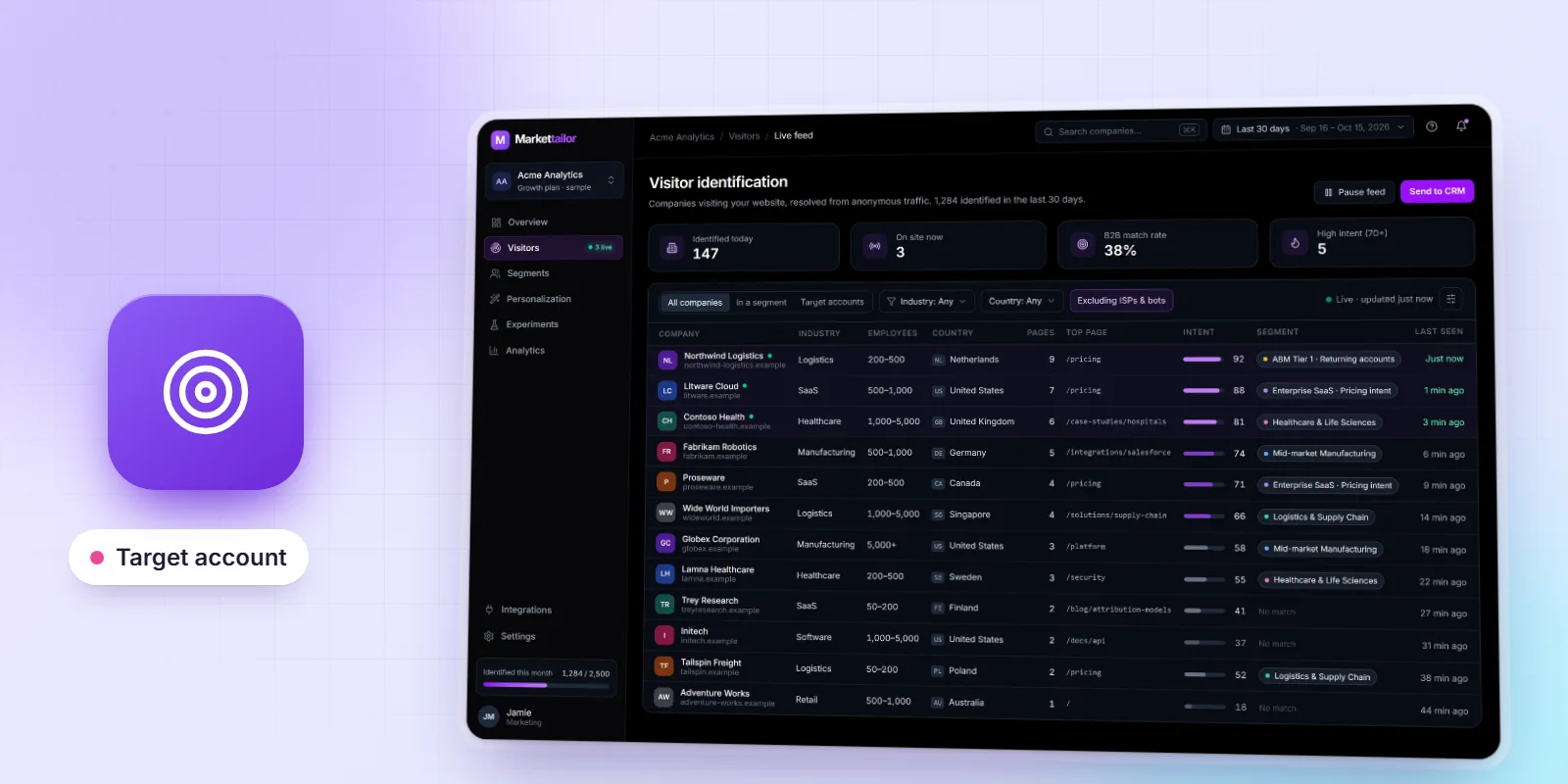
That recognition step is what Markettailor does: visitor identification matches anonymous visits to companies, and account-based personalization shows target accounts their own content while the rest of the traffic sees the default site.
Common Mistakes When Moving From Inbound to ABM
- Turning off inbound to fund ABM. Inbound is often how target accounts first find you. Cutting it removes the signal ABM depends on.
- Measuring ABM with lead metrics. An ABM programme will produce fewer leads by design. Judge it on account engagement and pipeline against accounts you did not target.
- A list that is too long. A thousand "target accounts" with no extra effort per account is demand generation with a spreadsheet attached.
- No agreement with sales. ABM without sales choosing and working the accounts is just targeted advertising.
Frequently Asked Questions
What is the difference between account-based marketing and inbound marketing?
Inbound marketing attracts buyers with content and lets them come to you, so you do not choose who arrives. Account-based marketing starts from a named list of target accounts and directs marketing at those companies. Inbound is measured on traffic and leads; ABM is measured on target account engagement and pipeline.
What is the difference between ABM and demand generation?
Demand generation builds pipeline from the whole market through many channels and qualifies whoever responds. ABM works a defined list of accounts agreed with sales, plans plays per account or per cluster, and measures success account by account against a control group.
Can you do ABM and inbound marketing at the same time?
Yes, and most B2B companies should. Inbound brings target accounts to the website; ABM recognizes them there and gives them a more relevant experience and faster sales follow-up. The default site stays written for inbound, and only target accounts see the personalized version.
Is ABM better than inbound marketing?
Neither is better in general. ABM fits when deals are large and the number of possible customers is small enough to name. Inbound fits when buyers search for the problem and many companies could buy. Many teams run inbound for the whole market and ABM for the top accounts.
What is the account-based marketing funnel?
An ABM funnel counts accounts, not leads. It starts with a fixed list of target accounts and tracks how many become aware, engaged, qualified and opportunities, and how many are won. Because the top of the funnel is fixed, the goal is to move a higher share of the list through each stage.